

Dish guide
Fish amok
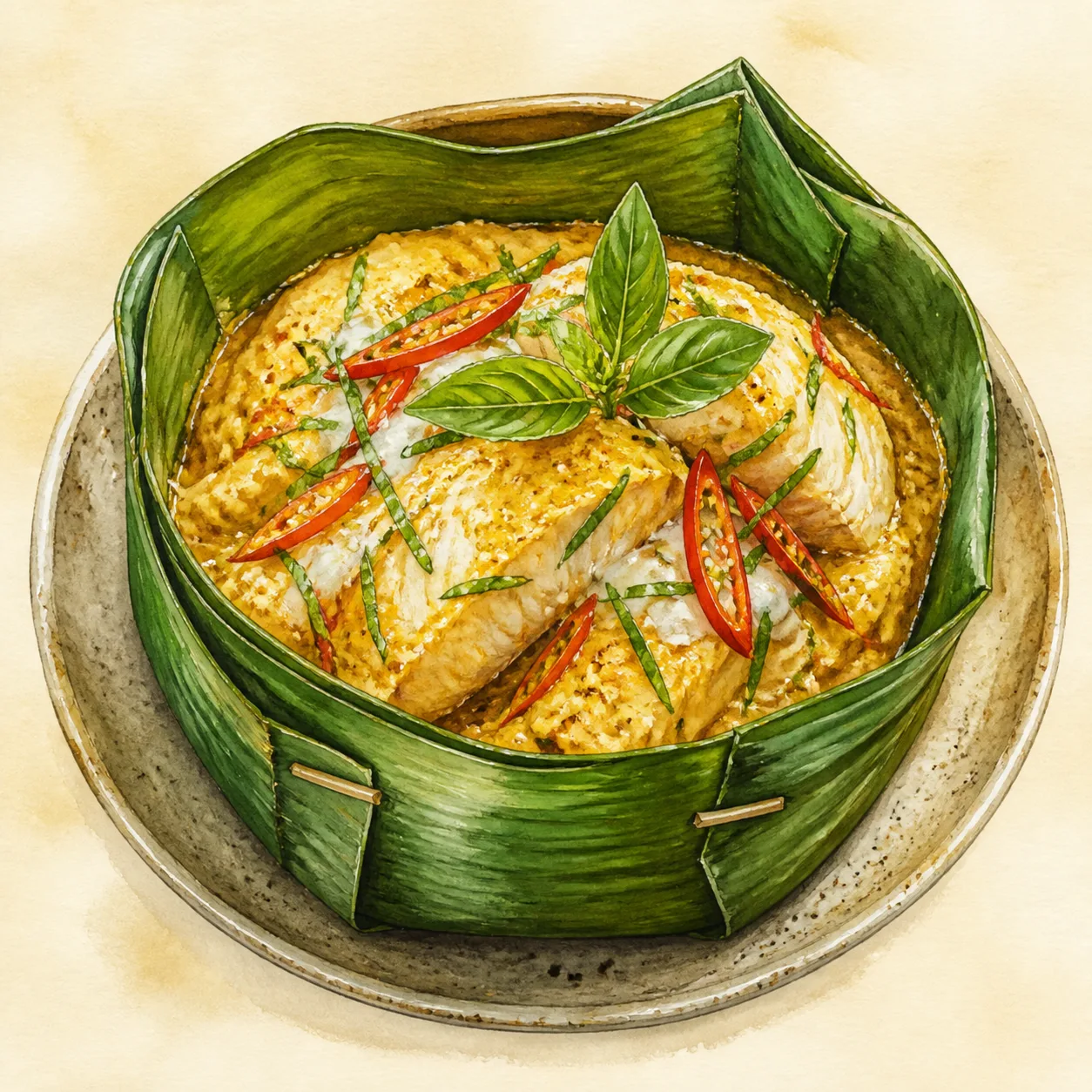
Fish amok—amok trei in Khmer—is a gently steamed preparation of fish, coconut and kroeung, often enriched and set with egg. It is one of the foods most closely associated with Cambodia, and a dish through which Khmer cooking is often introduced to visitors.
It is frequently called Cambodia's national dish or signature dish. That language captures the pride and recognition attached to amok, but it should not be mistaken for a settled official designation or a claim that one food can speak for every Cambodian table. The Royal Embassy of Cambodia in London calls Fish Amok a popular signature dish; on the same cultural guide it notes that local voters selected samlor korkor as the country's “true national dish.” Both ideas belong in an honest account of Cambodian food: Fish Amok is a powerful culinary icon, while Cambodia's living food culture is broader than one emblem.
Its history also deserves care. Cambodia's Ministry of Tourism describes the loss and dispersal of culinary records during the Khmer Rouge period, and mentions amok among dishes documented in royal cuisine. That supports a courtly association in surviving writing; it does not prove a single, unchanged palace recipe or settle the dish's deeper origin. The responsible story is one of continuity, recovery and adaptation rather than a tidy origin myth.
What makes an amok recognisable is its perfume and texture. A fresh, pounded kroeung brings lemongrass, galangal, turmeric and fragrant lime leaf; coconut rounds the aromatics; and gentle steaming gives the mixture a light savoury-custard set. The result should be aromatic and silky, never a heavy or aggressively hot curry.
Fish matters both practically and culturally: freshwater fish have long been central to Cambodian foodways, and cooks choose what is good and available. A leaf cup—often banana leaf—makes the steaming vessel part of the presentation, while a ceramic ramekin is a useful home alternative. A Ministry of Tourism account also documents a noni-leaf version.
There is no one authoritative amok. The fish, kroeung, degree of egg enrichment, leaf lining and service all vary by household, season and setting. This guide treats those variations as evidence of a living Khmer tradition, not as deviations from an imagined single original.
Names
- km / Khmr / preferred
- អាម៉ុកត្រី — amok trei
Continue exploring
Recipes
Explore the place
CambodiaThis dish is associated with Cambodia in the cited editorial reference; this is not an exclusive origin claim.
Regional context
- Central Cambodia
- DocumentedIn: Validation relationship for the initial Cambodia content slice.
Food traditions
- Khmer cuisine
Understand the technique
Understand the ingredients
Sources
-
10 Best Cambodian Foods Every Visitor Should Eat
, Royal Embassy of Cambodia in London
— https://www.cambodiaembassyuk.org/10-best-cambodian-foods-every-visitor-should-eat/ (accessed 2026-09-03)— Cambodian Embassy cultural guide identifying Fish Amok as a signature dish while recording the national-dish distinction made by local voters. -
Cambodian Fish Amok
, Chef Nak
— https://www.chefnak.com/cambodian-fish-amok (accessed 2026-10-08)— Cambodian chef's account of fish amok's kroeung, coconut, egg and gently steamed, silky texture. -
Fish Amok Recipe
, Royal Embassy of Cambodia in London
— https://www.cambodiaembassyuk.org/fish-amok-recipe/ (published 2022-02-11) (accessed 2026-10-08)— Cambodian Embassy recipe reference for the fish, kroeung, coconut, egg, leaf-lined and steamed variations described on this page.